| Student_ID | Courses |
|---|---|
| 2025097963 | 9 |
| 2025091648 | 9 |
| 2025097782 | 12 |
| 2025093288 | 10 |
| 2025093709 | 8 |
| 2025091864 | 10 |
| 2025094798 | 15 |
Case Illustration: Econometric Analysis
Understanding Policies (10700193-90)
Overview
- WHAT & WHY
- An analysis on how many data points?
- Why not experiments?
- What do we look for with LNA?
- HOW

Why Does CLT Require Over 1,000?

The larger the better?
\[\text{Margin of Error (M.E.)} = Z \times \frac{S}{\sqrt n}.\]
| Sample Size (n) | Margin of Error (M.E.) |
|---|---|
| 200 | 7.1% |
| 1000 | 3.2% |
| 2000 | 2.2% |
| 4000 | 1.6% |
Now you know how large is large! Good for you 👍🎉
Univariate Analysis

How to Describe a Variable

Levels of Descriptive Statistics
- Number
- Statistics
- Plot
| Unique | Missing Pct. | Mean | SD | Min | Median | Max | Histogram | |
|---|---|---|---|---|---|---|---|---|
| mpg | 25 | 0 | 20.1 | 6.0 | 10.4 | 19.2 | 33.9 |  |
| disp | 27 | 0 | 230.7 | 123.9 | 71.1 | 196.3 | 472.0 |  |
| hp | 22 | 0 | 146.7 | 68.6 | 52.0 | 123.0 | 335.0 |  |
| drat | 22 | 0 | 3.6 | 0.5 | 2.8 | 3.7 | 4.9 |  |
| wt | 29 | 0 | 3.2 | 1.0 | 1.5 | 3.3 | 5.4 |  |
| qsec | 30 | 0 | 17.8 | 1.8 | 14.5 | 17.7 | 22.9 |  |
| N | % | |||||||
| cyl | 4 | 11 | 34.4 | |||||
| 6 | 7 | 21.9 | ||||||
| 8 | 14 | 43.8 | ||||||
| vs | FALSE | 18 | 56.2 | |||||
| TRUE | 14 | 43.8 | ||||||
| gear | 3 | 15 | 46.9 | |||||
| 4 | 12 | 37.5 | ||||||
| 5 | 5 | 15.6 |
Bivariate Analysis
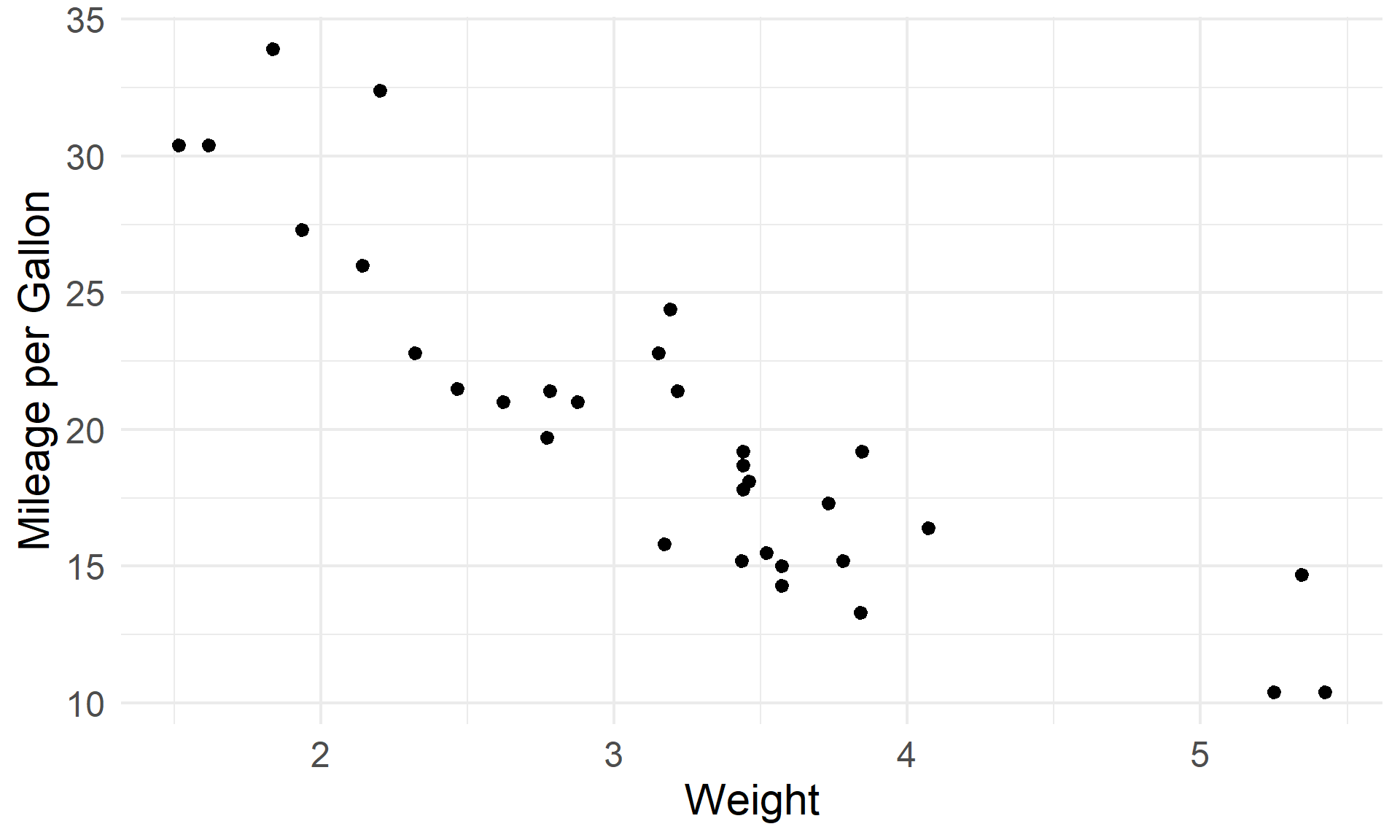
Not Always Reliable
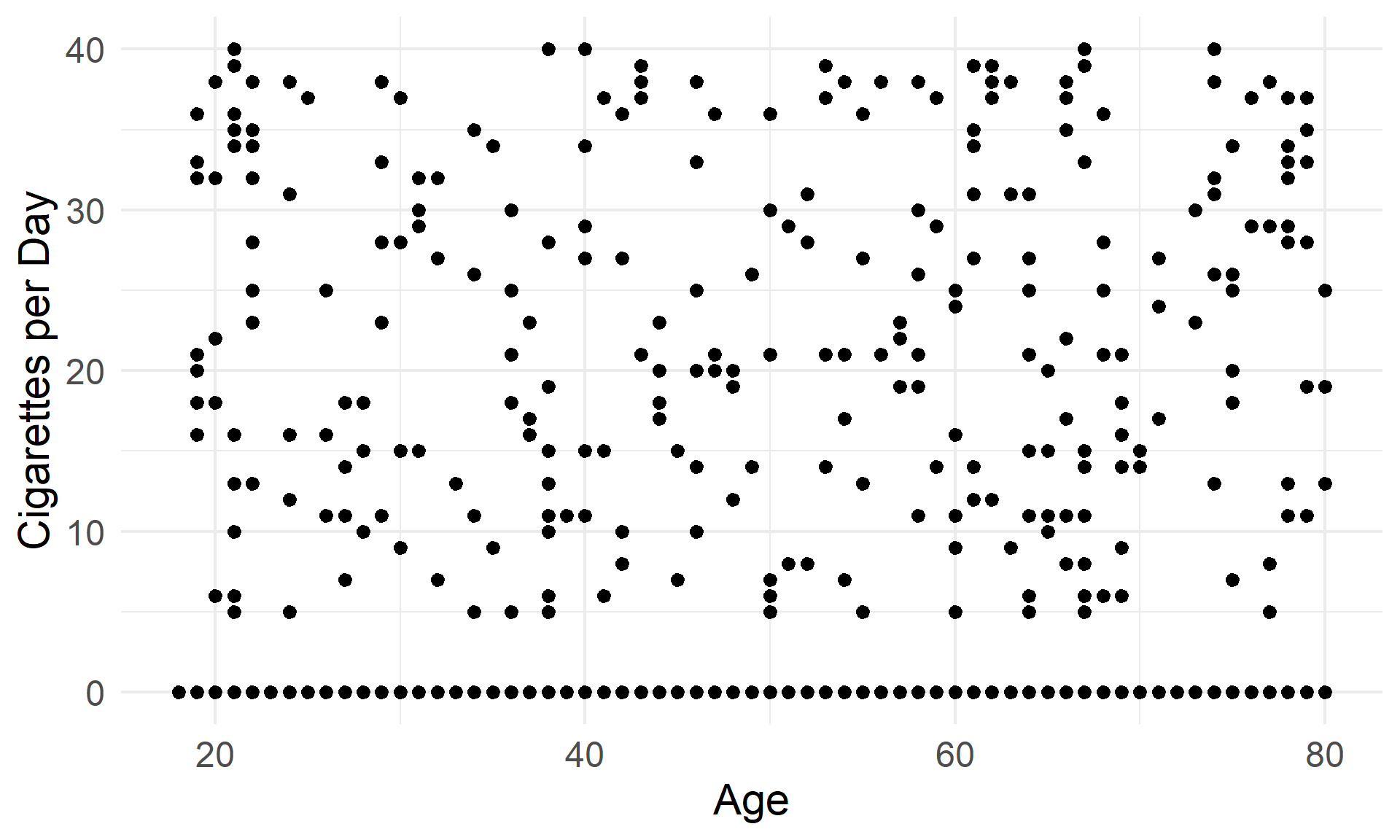
Multivariable Analysis


Present Your Model Efficiently
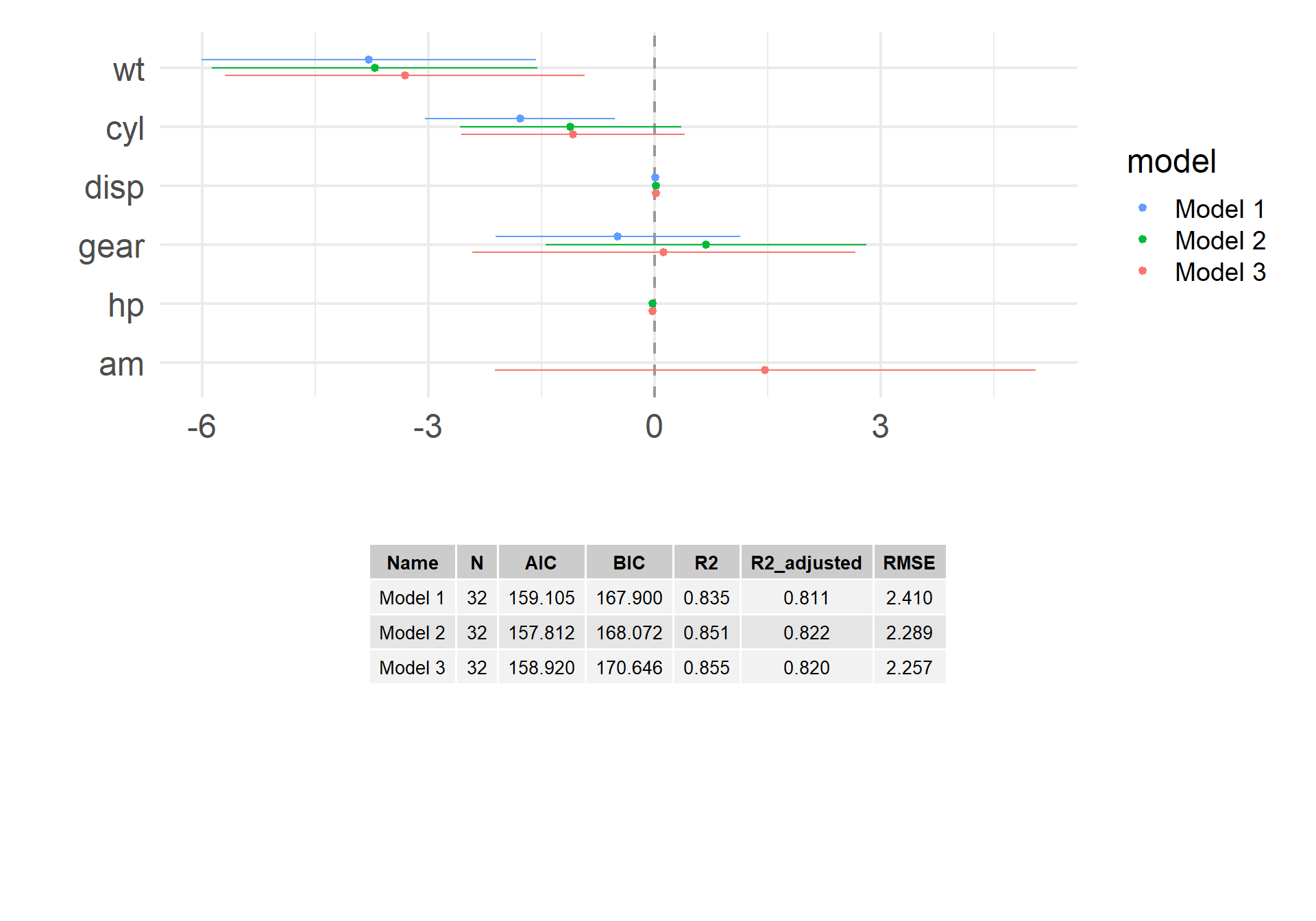
Example 1: Hukou Policy and Migration Decisions? (Pizzi and Hu 2022)
Research Question
Does governmental hukou (户口) policy shape migrants’ destination choices in China?
- Cities set their own rules: how hard to acquire local hukou, and what benefits it confers
- Millions migrate despite strict policies — so what actually matters?

Why this is a large-N problem
- Hukou policy varies across hundreds of cities
- Individual migration choices are noisy — only patterns across thousands of cases reveal policy effects
- Need enough variation to separate hukou effects from economic ones
Findings: Hukou as a Barrier?


Findings: Hukou as a Benefit?


Example 2: English-Learning Policy and Political Minds? (胡悦 and 朱萌 2022)

Why this is a large-N problem
- Language effects on political cognition are subtle and cumulative — only detectable across thousands of respondents
- Need enough variation in English proficiency to separate language effects from education, income, and other confounders
Research Question
Does English proficiency shape Chinese citizens’ political cognitive capabilities?
- China has 400+ million English learners — a product of 40 years of mandatory education
- But does this language learning change how people think about politics?
Findings: What Drives Political Capability?

