Hypothesis Testing: Concept and Operation
Large N & Leeuwenhoek (70700173)
1.3 How to get confidence


2.6 About alpha

2.7 Why 0.05
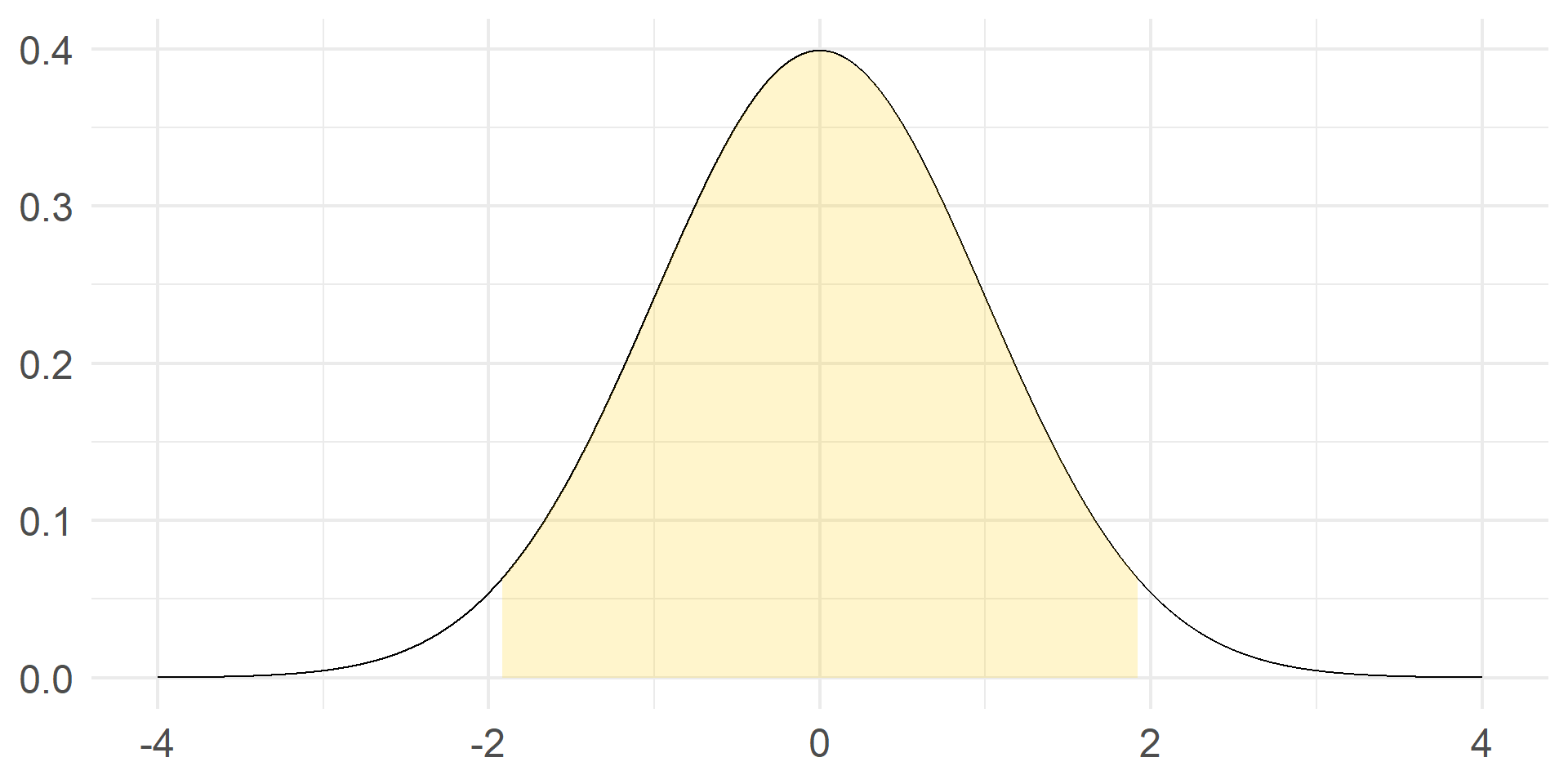
It’s not arbitrary, α = 0.05 ⇒ 1 - α = 0.95 (one-tailed) or 0.975 (two tailed)
Well…it’s actually arbitrary annnnnnnnnnd qualitative.
2.8 How to get p < 0.05

习近平在中央党校(国家行政学院)中青年干部培训班开班式上的讲话(2022年3月1日)
守住拒腐防变防线,最紧要的是守住内心,从小事小节上守起,正心明道、怀德自重,勤掸“思想尘”、多思“贪欲害”、常破“心中贼”,以内无妄思保证外无妄动。
2.11 Correct SE ![]()

Finite population correction
For small population, not small sample.
- FPC: Without replacement, SE of X̄ ↑ ⇒ uncertainty overestimated ⇒ correction: \(\sqrt{\frac{N - n}{N - 1}}\)
- n = 1 (sampling only one sample), Then \(SE = \frac{\sigma}{\sqrt{n}}\sqrt{\frac{N - n}{N - 1}} = \frac{\sigma}{\sqrt{n}}\);
- n = N (sampling all), SE = 0.
- n = 1000, N = 100,000,000 (large sample of a large population), \(FPC = \sqrt{\frac{100000000 - 1000}{100000000 - 1}}\approx .999\), little changes.
- n = 100, N = 108 (large sample of a small population), \(FPC = \sqrt{\frac{108 - 100}{108 - 1}}\approx 0.075\), some changes.
2.12 What does the FPC correct

2.15 Full Process Illustration
Given a virus can influence 10% of the population. Now there’s a sample of senior people, n = 527, within which there are 14% infected. Are senior people more likely to be victimized?

2.16 Take-home point

Meditation
